
Digital transformation has become essential for charities navigating today’s complex landscape, from rising service demand and economic pressures to changing user expectations. The Charity Digital Skills report has grown substantially in the last few years, from 435 responses in 2022, to 672 in 2025. Each year, the Charity Digital Skills Report gives us a clearer picture of how the sector is responding, where progress is being made, and what gaps remain.
Now in its eighth year, the 2025 report sheds light on the growing role of digital tools, the increasing use of AI, and the persistent barriers that are holding some organisations back. Whether you’re a charity leader, digital practitioner, or funder, these insights can help inform priorities and planning for the months ahead.
Digital is now a Priority
A significant shift is taking place: digital is no longer seen as an add-on or optional investment. According to the report, 74% of charities now say digital is a strategic priority, the highest proportion to date.
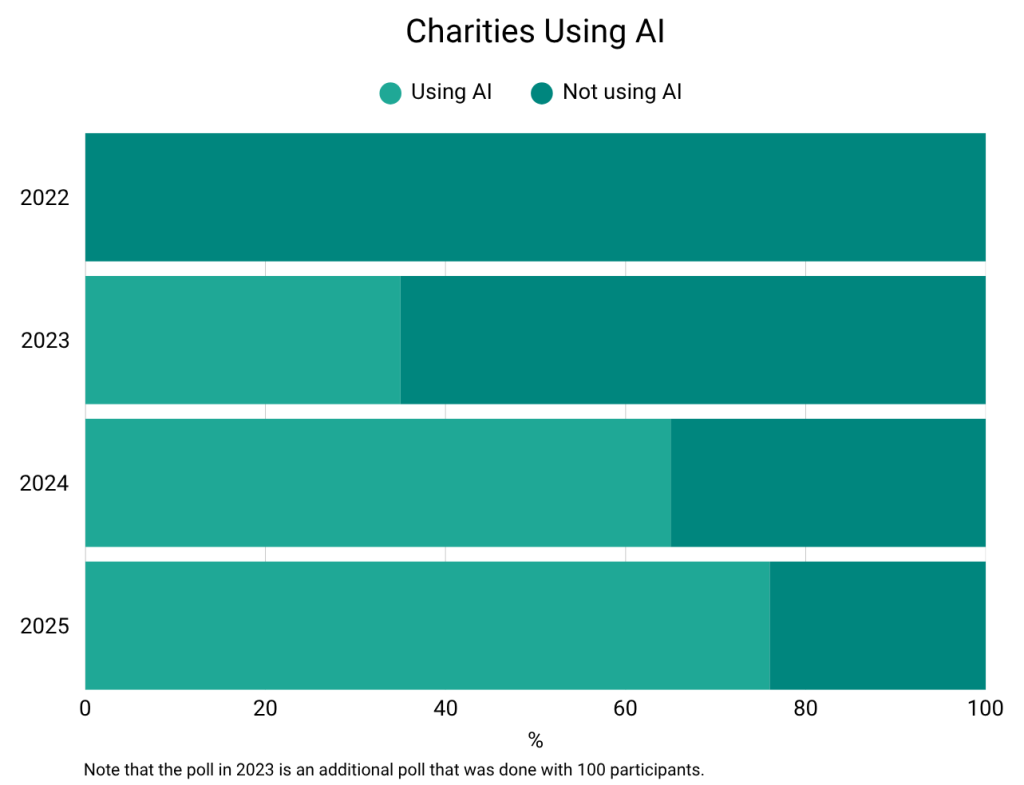
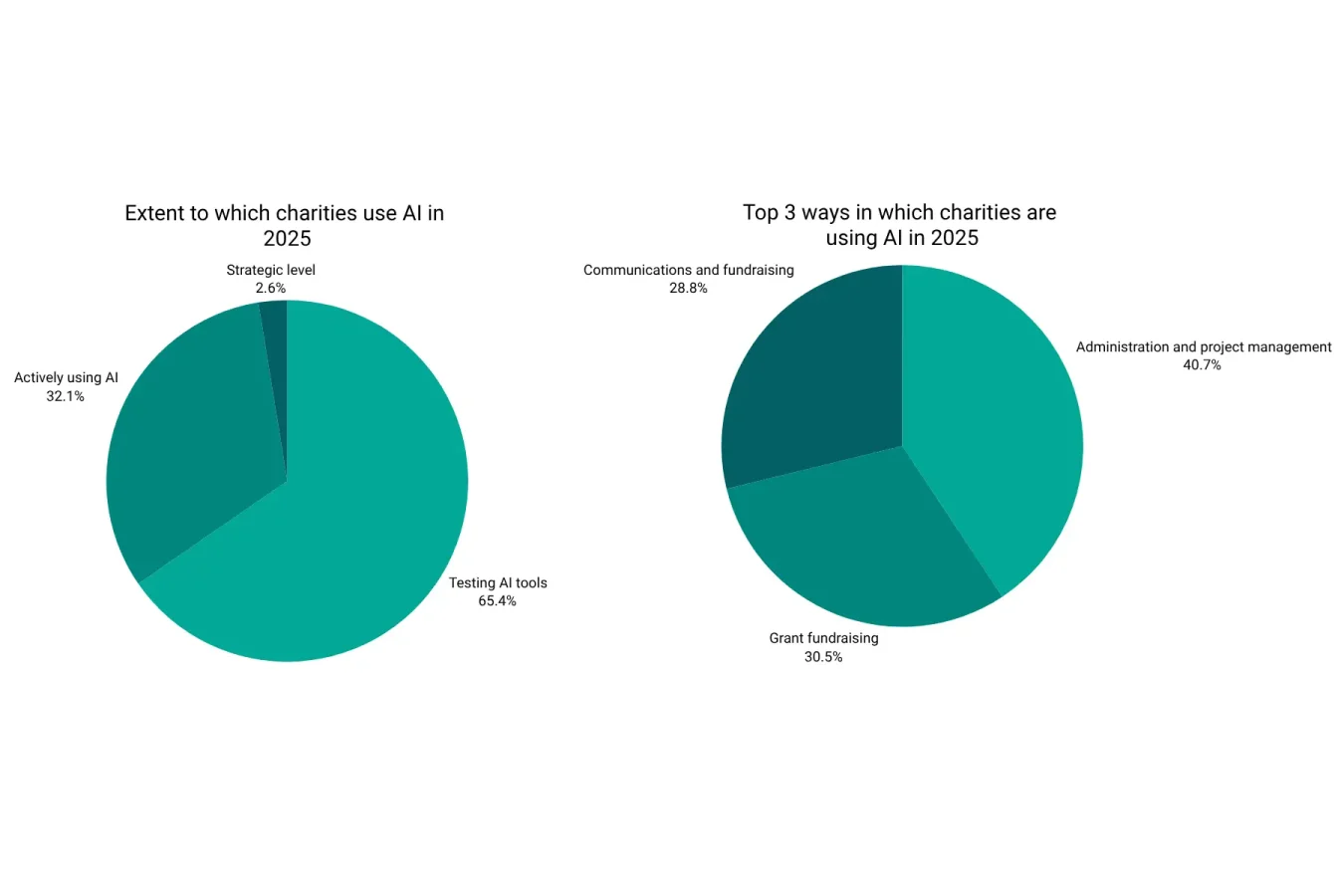
There’s also been a major leap in the use of artificial intelligence, with 76% of charities using AI in some capacity. Compared to just 65% last year and 35% the year before. This includes tools for fundraising, internal processes, and communications.
However, the picture isn’t uniformly positive. While appetite is growing, the strategic foundations are not always in place. Only 44% of charities have a digital strategy, down from 50% in 2024. Suggesting a bit of a disconnect between enthusiasm for digital and the planning needed to use it effectively.
It’s encouraging to see some of our local charities already investing significant effort into understanding AI’s potential.
Digital Confidence is Still low in Some Areas
The gaps in fundamental digital skills remains a challenge for the sector throughout leadership and volunteers. Just 18% of charities rate their use of digital in service delivery as “excellent.” Many continue to face practical barriers such as legacy systems, tight budgets, and a lack of internal skills.
Investment in digital skills remains a sticking point, 40% of charities rate themselves poorly at investing in digital tools and staff training. Leadership confidence is also low. 28% of charities say their boards have poor digital skills, unfortunately way higher than last year (19%).
AI is also widening the gap between large and small charities. As 68% of small charities are still at early stages in their digital development.
Funding Challenges
The lack of funders providing dedicated support for digital projects is a recurring problem.
27% of charities overall say finding a funder is the biggest barrier for supporting a digital project. Notably, finding funding for digital projects disproportionally affects 44% of black led charities.
The lack of funding has led some charities to look elsewhere for digital funding. While 12% got digital funding from local authority grants another 11% got corporate funding.
While funders seem more aware of the need of funding for digital projects, there’s not been a significant increase in actual, accessible funding. Especially for long term capacity building projects.
Data and AI are top of Mind, but not Well Understood
Nearly half (49%) of charities are prioritising digital, data and AI development strategies. A majority (74%) say AI is relevant to them, and 48% are actively developing an AI policy (risen from 16% in 2024). Amongst larger charities 68% are developing a AI policy.
These figures suggest the sector is approaching a pivotal moment, with growing awareness and strategic planning laying the foundations. Though the report notes there’s further to go with internal digital skills.
Data use continues to be a challenge. While charities understand its potential value, many struggle to translate data into actionable insights. For example, 39% say they don’t make effective use of their website or analytics data. Data governance and compliance also remain areas of some uncertainty.
When it comes to AI, uptake has soared, but responsible use is still a work in progress. Many charities are experimenting with generative AI for content creation or productivity, but questions around ethics, bias, and transparency are increasingly coming to the fore.
Real-world AI Applications in the Charity Sector
While many charities are still exploring where to begin with AI, others are already using it to scale support, save time, and personalise their services. Chatbots, content translators, and generative writing tools are just some of the most accessible starting points.
Similar patterns are emerging across the public sector. Local governments are using AI to ease pressure on stretched services, whether it’s answering council tax queries through virtual assistants or creating accessible documents. Swindon Borough Council’s use of AI to generate “Easy Read” content is one example of how this technology can support inclusion and reduce manual workloads.
These innovations point to a shared challenge: doing more with less, while keeping people at the centre. Whether in local councils or community charities, AI is proving itself not as a replacement, but as a tool to increase capacity and impact.
You can find more global examples in our earlier blog: AI for Social Good: positive use cases.
Why Digital Still Matters for Charities
It’s easy to view digital transformation in charities primarily through the lens of automation. And while automating tasks like donation processing or volunteer sign-ups is incredibly valuable, especially to charities with limited capacity. The bigger picture reveals much deeper benefits, and some striking gaps.
Digital channels expand a charity’s reach, whether through chatbots, translated content, or AI-generated Easy Read documents. But only 44% of charities have a digital strategy in place, down from 50% the year before. This means many aren’t fully tapping into digital’s potential to make services more inclusive and scalable.
Cloud platforms, data dashboards and shared systems can help charities work more closely with public sector partners and funders. Yet while many nonprofits collect good data, Data Orchard found that skills and confidence are a major issue, over 75% of charities report low data literacy.
Sector-wide Support is Still Needed
This year’s report calls attention to the wider context: charities are under pressure from rising service demand, economic uncertainty, and digital exclusion. Many are trying to balance innovation with the need to be inclusive and accessible. Funding for digital transformation in the charity sector remains limited, fragmented, and often tied to short-term or innovation-focused projects rather than long-term capacity building.
There is growing demand for more affordable digital tools, better funding for infrastructure, and clearer guidance on topics like cybersecurity, sustainability, and ethical AI use.
Funders and sector bodies have a key role to play here. Charities are asking for more flexible funding, longer-term digital support, and access to expert advice and training. As the sector evolves, collaboration between charities, funders, policymakers, and tech partners will be critical in building lasting digital resilience.
Conclusion
AI, data, and automation have increasingly embed themselves in day-to-day service delivery. Yet this progress is uneven. While some charities are pioneering innovative uses of technology, many remain held back by funding gaps, legacy systems, and low confidence across leadership and staff.
This year’s report shows that digital is increasingly seen as strategic, but strategy without investment, skills, or long-term support won’t deliver lasting impact. The risk is a widening digital divide between larger, better-resourced charities and smaller organisations with limited capacity to explore new tools.
As the sector continues to adapt, the need for shared infrastructure, clearer guidance, and collaborative funding models is more urgent than ever. With the right support, charities can use it to build more inclusive, agile, and resilient services for the communities they serve.


